Manufacturing architectures become fragile when ERP is asked to behave like a line system, SCADA is stretched into a production-record system, or an IoT platform is expected to replace execution. MES is the operational bridge between the business plan and what actually happens on the floor.
Four systems, four different jobs
ERP is designed around orders, inventory, finance, procurement and enterprise planning. SCADA and control systems are designed around machine state, alarms, supervision and process control. Industrial IoT connects heterogeneous devices and moves data reliably across sites.
MES sits between those layers. It turns released demand into executable work, guides operators through routing and work instructions, records what was produced, maintains genealogy, captures quality events and measures performance against the production standard.
Why the boundary matters
When responsibilities blur, teams create duplicate master data, conflicting production status and brittle point-to-point interfaces. A schedule may look complete in ERP while a line is waiting on a quality hold that exists only in a local spreadsheet.
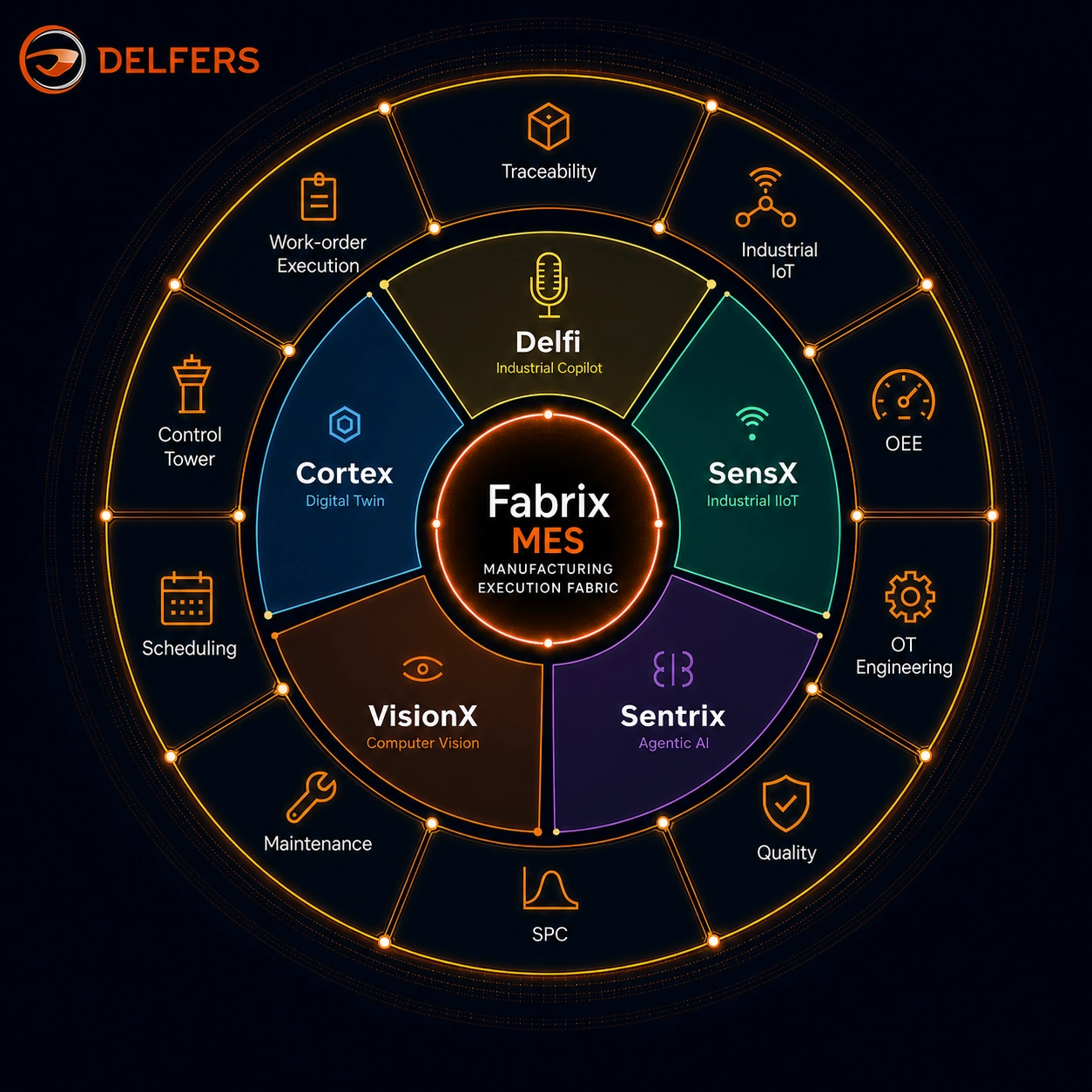
Fabrix owns execution state, traceability, quality workflow and production context. SensX and the OT layer provide resilient machine connectivity while ERP remains the enterprise system of record for business transactions.
Use ISA-95 as a conversation model
ISA-95 is useful because it gives operations and IT a common vocabulary for the boundary between enterprise planning and manufacturing operations. The goal is not to reproduce every box from a standard. The goal is to agree which system owns each object, event and decision.
A modern deployment usually needs a small number of governed interfaces: production orders and material context moving down, confirmed production and consumption moving up, and operational events captured close enough to the line to preserve their meaning.
- Define the system of record for work orders, materials, routings and equipment
- Separate machine-state acquisition from production-event interpretation
- Design idempotent interfaces so retries do not create duplicate records
- Keep local execution resilient when enterprise connectivity is unavailable
Composition is stronger than consolidation
The goal is not one giant application. It is a set of layers that cooperate cleanly. Fabrix provides the execution fabric, SensX provides connectivity, VisionX adds visual evidence, Cortex adds operational modelling, and Sentrix can reason over governed context.
That composition keeps the architecture understandable and allows each layer to evolve without rewriting the entire factory stack.
Standards and primary sources used for context.
These links provide technical context. Their inclusion does not claim product certification or compliance unless explicitly stated elsewhere.